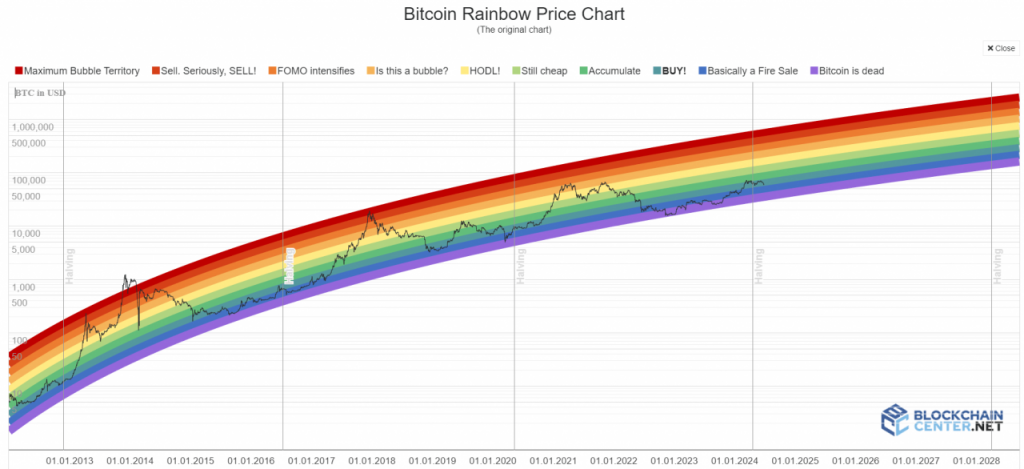
The Bitcoin Rainbow Chart is more than just a colorful visual; it’s a fascinating tool that captures the dynamic nature of Bitcoin’s price trends over time. It offers a unique perspective for both traders and long-term investors, guiding them through the often turbulent waters of cryptocurrency.
Originating from the need to simplify the complex nature of Bitcoin trading, the Rainbow Chart employs a color-coded system that represents various price bands, helping users understand where Bitcoin might be headed based on historical data. Each band is meticulously crafted to reflect significant trends, making it an invaluable asset in the cryptocurrency landscape.
Overview of Bitcoin Rainbow Chart
The Bitcoin Rainbow Chart is a visual tool designed to provide insights into the price trends and market cycles of Bitcoin over time. Utilizing a color-coded system, the chart highlights different phases of Bitcoin’s price action, which can help traders and investors make informed decisions. By showcasing historical price movements in relation to a series of color gradients, the Rainbow Chart aims to simplify complex market data into easily understood visual information.The concept of the Bitcoin Rainbow Chart was formulated by a cryptocurrency enthusiast known as “Trololo,” who created this tool to help visualize Bitcoin’s long-term price trends.
First introduced in 2014, it emerged from the growing need for a straightforward method to assess Bitcoin’s cyclical nature and potential future movements. The chart is based on logarithmic regression, which is a statistical technique often used to analyze the relationship between variables that diverge exponentially, making it particularly suitable for assets like Bitcoin that have experienced astronomical growth since inception.
Visual Representation and Color Coding
The Bitcoin Rainbow Chart employs a spectrum of colors to represent different price zones, each indicative of a specific market sentiment and phase. The colors range from deep red to vibrant purple, with each color representing a distinct price level and corresponding market condition. The chart is designed to visually communicate whether Bitcoin is potentially overvalued or undervalued, assisting users in recognizing buying or selling opportunities.The color coding within the chart can be summarized as follows:
- Dark Red: Represents extreme overvaluation, suggesting a market bubble or correction is likely.
- Red: Indicates high overvaluation, signaling caution for potential investors.
- Orange: Signifies a neutral to slightly overvalued phase, where market dynamics are volatile.
- Yellow: Suggests a balanced market, with a healthy mix of buyer and seller activity.
- Green: Indicates undervaluation, presenting potential buying opportunities.
- Blue: Represents deep undervaluation, generally a signal for long-term investors.
- Purple: Depicts a historical low, suggesting a strong buying opportunity, often associated with market bottoms.
This color-coded representation provides a quick reference for traders and investors to gauge market sentiment at a glance, allowing for quicker decision-making based on historical patterns. The Rainbow Chart serves not only as a price indicator but also as a reminder of Bitcoin’s volatile nature, emphasizing the importance of understanding market cycles when investing.
Components of the Bitcoin Rainbow Chart

The Bitcoin Rainbow Chart is a popular visual tool used by investors and enthusiasts to analyze Bitcoin’s price trends over time. It is composed of several distinct bands, each representing different price zones that can help predict potential future movements. Understanding these components is crucial for anyone looking to grasp the overall sentiment in the Bitcoin market.The chart is segmented into various colored bands, each indicating a different range of price expectations.
These bands are based on a logarithmic regression model, which provides a more holistic view of price movements relative to the historical performance of Bitcoin. Each color signifies a specific zone, which correlates with the sentiment of market participants at any given time.
Zones and Their Significance
The significance of the color-coded bands within the Bitcoin Rainbow Chart lies in their ability to represent potential price trends and market sentiment. Here’s a breakdown of the zones:
- Red Zone: Represents overbought conditions, indicating that Bitcoin is potentially overvalued. Prices in this range often signal that a correction may be imminent.
- Orange Zone: Suggests that Bitcoin is nearing its peak. It’s a warning to investors to be cautious as prices might soon decline.
- Yellow Zone: Indicates a transitional phase where prices may begin to stabilize. This zone often sees increased volatility.
- Green Zone: Typically represents fair value. It suggests that Bitcoin is trading at a reasonable price level based on its historical performance.
- Light Blue Zone: Signals accumulation opportunities, as Bitcoin is considered undervalued at this stage. Investors may look for buying opportunities.
- Dark Blue Zone: Represents extreme undervaluation, often characterized by a bear market. This zone typically coincides with long-term buying opportunities.
The transition between these bands reflects changes in investor sentiment and market conditions, allowing traders to gauge potential future price movements.
Methodology Behind the Bands
The methodology employed in creating the Bitcoin Rainbow Chart involves a logarithmic regression analysis of Bitcoin’s historical price data. This approach smooths out the price volatility typically associated with cryptocurrencies, providing a clearer long-term perspective. The bands are derived from a mathematical model that fits Bitcoin’s historical price data to a curve, allowing for the determination of future price zones.The calculation of the bands uses historical data points, which are continually updated as new price information becomes available.
This ensures that the chart remains relevant and reflects current market conditions. Each band is placed at specific price levels calculated from this regression analysis, which helps in providing visual cues for potential buy and sell decisions based on historical performance trends.The combination of historical analysis and visual representation makes the Bitcoin Rainbow Chart a valuable tool for traders looking to navigate the often unpredictable cryptocurrency market.
Interpretation of the Bitcoin Rainbow Chart
The Bitcoin Rainbow Chart serves as a visual representation of Bitcoin’s price history and potential future price movements. This chart leverages historical data to map out various levels of price growth and contraction, depicted through a spectrum of colors. Understanding how to read this chart is crucial for investors who want to gauge market sentiment and make informed decisions based on past trends.Reading the Rainbow Chart effectively involves recognizing the different color bands, each indicating a specific price range.
The bottom band represents extreme undervaluation, while the top band signifies extreme overvaluation. Investors should pay attention to the current price position relative to these bands, allowing them to assess whether Bitcoin is in a buying or selling zone. Additionally, historical price movements can provide context for current market behavior, offering a more nuanced interpretation of future possibilities.
Guidelines for Effective Interpretation
To navigate the Rainbow Chart successfully, consider the following guidelines:
Understand Color Significance
Each color on the chart corresponds to a specific valuation zone, from undervaluation to overvaluation. It’s essential to familiarize yourself with what each color indicates.
Price Position Awareness
Observe where the current Bitcoin price sits within the color bands. A price near the lower end might suggest a buying opportunity, whereas a price near the upper end could indicate potential overvaluation.
Historical Context
Look at previous price movements in relation to the chart to identify patterns or recurring behaviors. This historical perspective aids in forecasting future price movements.
Market Sentiment
Use the chart in conjunction with other market indicators to gauge overall sentiment. The Rainbow Chart is one tool among many, and understanding broader market trends can enhance your interpretation.
Comparison with Other Price Prediction Models
The Rainbow Chart stands out among various Bitcoin price prediction models due to its simplistic yet effective visualization. Unlike more complex models, such as stock-to-flow, which rely heavily on supply dynamics, the Rainbow Chart focuses on price history and market psychology. Other models might utilize macroeconomic factors, technological advancements, or market cycles, resulting in diverse interpretations of future valuations. For example, while the stock-to-flow model predicts Bitcoin prices based on scarcity and halving events, the Rainbow Chart emphasizes historical price action and market sentiment, making it more accessible for average investors.
By integrating insights from multiple models, investors can develop a more rounded understanding of Bitcoin’s potential trajectory.
Common Misconceptions Surrounding the Chart
Several misconceptions frequently arise regarding the interpretation of the Bitcoin Rainbow Chart. Addressing these can lead to more informed investment decisions:
Overreliance on Visuals
Some investors mistakenly believe that the Rainbow Chart guarantees specific outcomes based solely on its color bands. It’s vital to remember that the chart is a tool to gauge sentiment, not a crystal ball for precise price predictions.
Ignoring Market Trends
The chart’s historical focus can lead some to neglect current market signals or developments. Real-time market analysis should always complement the insights gained from the Rainbow Chart.
Assuming Uniform Behavior
Investors sometimes assume that Bitcoin will always behave in the same manner as it has in the past when hitting similar price zones. Market dynamics can change significantly due to external factors like regulations, technological advancements, or macroeconomic shifts.
“The Rainbow Chart should be viewed as a guideline to assist in decision-making rather than an infallible prediction tool.”
Applications of the Bitcoin Rainbow Chart
The Bitcoin Rainbow Chart serves as a visual tool that can significantly aid traders and investors in making informed decisions in the volatile cryptocurrency market. Utilizing this chart effectively can enhance understanding of market cycles and potential price movements. This section delves into various scenarios where the Rainbow Chart can be applied, demonstrating its utility for both short-term trading and long-term investment strategies.
Scenarios for Traders
Traders can leverage the Bitcoin Rainbow Chart to identify optimal entry and exit points based on the color-coded price bands. Each color represents a different phase in the market cycle, from “Buy” to “Sell.” The following scenarios illustrate how traders can utilize the chart:
- When the price of Bitcoin enters the blue band, indicating a period of undervaluation, traders might consider it a buying opportunity.
- Conversely, if Bitcoin reaches the red band, where the price is deemed overvalued, traders may opt to sell or short the asset.
- During transitions between bands, traders can monitor price action for potential breakout or reversal patterns, refining their trading strategy in real time.
Long-term Investment Strategies
The Rainbow Chart is particularly beneficial for long-term investors who seek to ride the overall upward trend of Bitcoin. By observing the historical performance reflected in the chart, investors can make strategic decisions around their portfolio.
- Investors can use the chart to buy during the blue and purple phases, which historically correspond to the best opportunities for long-term gains.
- Staying invested during the orange and red phases can help investors remain focused on long-term growth, despite short-term volatility.
- The chart can assist in setting price targets for long-term holds, allowing investors to plan profit-taking strategies aligned with the market cycle depicted in the chart.
Market Sentiment and Chart Predictions
The effectiveness of the Bitcoin Rainbow Chart’s predictions is significantly influenced by market sentiment. Understanding how collective investor emotions affect price movements is crucial for interpreting the chart.
- In bullish markets, the Rainbow Chart may show a stronger upward trend, prompting confidence among investors and potentially leading to higher price targets.
- During bearish conditions, sentiment can shift drastically, causing traders to second-guess their strategies, which may lead to price corrections that the chart might not initially predict.
- For example, when significant news or events arise, such as regulatory changes or technological advancements, the market sentiment can quickly turn, impacting the reliability of the chart’s color-coded signals.
Limitations of the Bitcoin Rainbow Chart
While the Bitcoin Rainbow Chart serves as a popular visual tool for predicting Bitcoin’s price movements, it is essential to recognize its limitations. Investors should approach this chart with caution and an understanding that it is not infallible. The chart’s reliance on historical data and trends means that it may not always accurately forecast future performance, especially in a volatile market like cryptocurrency.One of the primary drawbacks is that the Bitcoin Rainbow Chart is based on historical price data, which may not account for future market dynamics.
The financial landscape is constantly evolving, influenced by an array of factors that cannot be captured by past performance alone.
Drawbacks in Utilizing the Chart for Investment Decisions
Investors should be aware of several critical limitations associated with using the Bitcoin Rainbow Chart for making investment decisions. These limitations can lead to overly optimistic or misguided conclusions.
- Historical Bias: The chart is constructed using historical price trends, which can mislead investors by suggesting that past patterns will repeat in the future.
- Market Volatility: Bitcoin’s price is notoriously volatile, and sudden market events can drastically alter price trajectories, rendering previous trends ineffective as predictors.
- Over-reliance on Visuals: Investors may focus excessively on the chart without considering other essential analyses or market indicators, leading to uninformed decision-making.
Factors Influencing the Accuracy of Predictions
The accuracy of the Bitcoin Rainbow Chart’s predictions can be significantly affected by various external factors. Recognizing these influences is vital for the accurate interpretation of the chart’s indications.
- Regulatory Changes: Changes in government regulations regarding cryptocurrencies can lead to sudden shifts in market sentiment and prices.
- Technological Developments: Advances in blockchain technology or Bitcoin itself can alter investor perceptions and the overall demand for the cryptocurrency.
- Macroeconomic Conditions: Economic downturns, inflation rates, and global events can impact investor behavior, leading to unexpected price movements.
Impact of External Events on Chart Relevance
External events play a significant role in shaping the relevance of the Bitcoin Rainbow Chart. These events can disrupt established patterns and drastically change market dynamics.
- Market Sentiment: News events, such as security breaches or influential endorsements, can cause rapid shifts in market sentiment, influencing prices independent of historical trends.
- Global Economic Events: Major economic shifts, such as recessions or geopolitical conflicts, can lead to a sell-off in cryptocurrencies, decoupling them from their historical price patterns.
- Technological Crises: Issues like network congestion or problems with blockchain security can lead to immediate price declines, countering the optimistic trends suggested by the chart.
Future of the Bitcoin Rainbow Chart
The Bitcoin Rainbow Chart has been a useful tool for many investors and analysts in understanding the market’s potential trajectory. As the cryptocurrency landscape continues to shift, the chart itself may evolve to reflect new data and insights. This evolution could enhance its accuracy and reliability in predicting price movements and market trends.One significant factor in the future development of the Bitcoin Rainbow Chart is the changing market conditions influenced by various external factors such as regulatory developments, technological advancements, and macroeconomic trends.
As these elements fluctuate, the Rainbow Chart may adapt its parameters to provide more relevant analyses.
Potential Enhancements to Accuracy
To improve the accuracy of the Bitcoin Rainbow Chart, several updates or modifications could be considered. These potential enhancements might include:
- Incorporation of On-Chain Data: Utilizing more on-chain metrics, such as transaction volume and wallet activity, could provide deeper insights into market dynamics, offering a clearer picture of supply and demand factors.
- Integration of Sentiment Analysis: By analyzing social media trends and public sentiment towards Bitcoin, the chart could incorporate psychological market elements, which often play a critical role in price movements.
- Dynamic Scaling: Adjusting the scaling of the chart to account for extreme volatility during bull and bear markets could potentially yield more reliable price predictions.
- Advanced Machine Learning Models: Implementing machine learning algorithms to analyze historical data and market patterns might enhance the chart’s predictive capabilities, allowing for real-time updates based on fresh data inputs.
Influence of Emerging Technology
Emerging technologies could substantially impact the development of the Bitcoin Rainbow Chart. The advent of advanced analytics and artificial intelligence offers new opportunities for enhancing the chart’s predictive power. For instance:
- Blockchain Developments: Innovations in blockchain technology, including scalability solutions and improved transaction speeds, can lead to changes in market behavior that the Rainbow Chart would need to adapt to.
- Decentralized Finance (DeFi): The growth of DeFi platforms could affect liquidity and trading patterns, necessitating adjustments in the chart’s framework to account for these shifts.
- Data Visualization Tools: The emergence of new data visualization technologies may allow for more interactive and user-friendly representations of the Rainbow Chart, making it easier for investors to analyze trends and make informed decisions.
“The Bitcoin Rainbow Chart is a living document that must evolve alongside the dynamic cryptocurrency market to maintain its relevance and accuracy.”
Wrap-Up
In summary, the Bitcoin Rainbow Chart serves as a vibrant yet analytical guide for anyone looking to navigate the Bitcoin market. By understanding its components, limitations, and potential applications, traders and investors can make more informed decisions, turning the chaos of cryptocurrency into a more predictable journey.
Detailed FAQs
What is the Bitcoin Rainbow Chart?
The Bitcoin Rainbow Chart is a visual tool that uses color bands to represent potential price trends of Bitcoin, helping traders and investors assess market behavior.
How do I interpret the colors on the Bitcoin Rainbow Chart?
Each color band on the chart signifies a different price zone, with colors transitioning from red (overbought) to green (undervalued), indicating potential buying or selling points.
Can I rely solely on the Bitcoin Rainbow Chart for trading decisions?
While the chart provides valuable insights, it should be used in conjunction with other analysis tools and market research for informed trading decisions.
How often is the Bitcoin Rainbow Chart updated?
The chart is typically updated based on significant price changes and market trends, but users should check regularly for the latest data.
Are there any risks associated with using the Bitcoin Rainbow Chart?
Yes, like any predictive tool, the Bitcoin Rainbow Chart has limitations and should not be the sole basis for investment decisions, as external factors can significantly impact the market.